
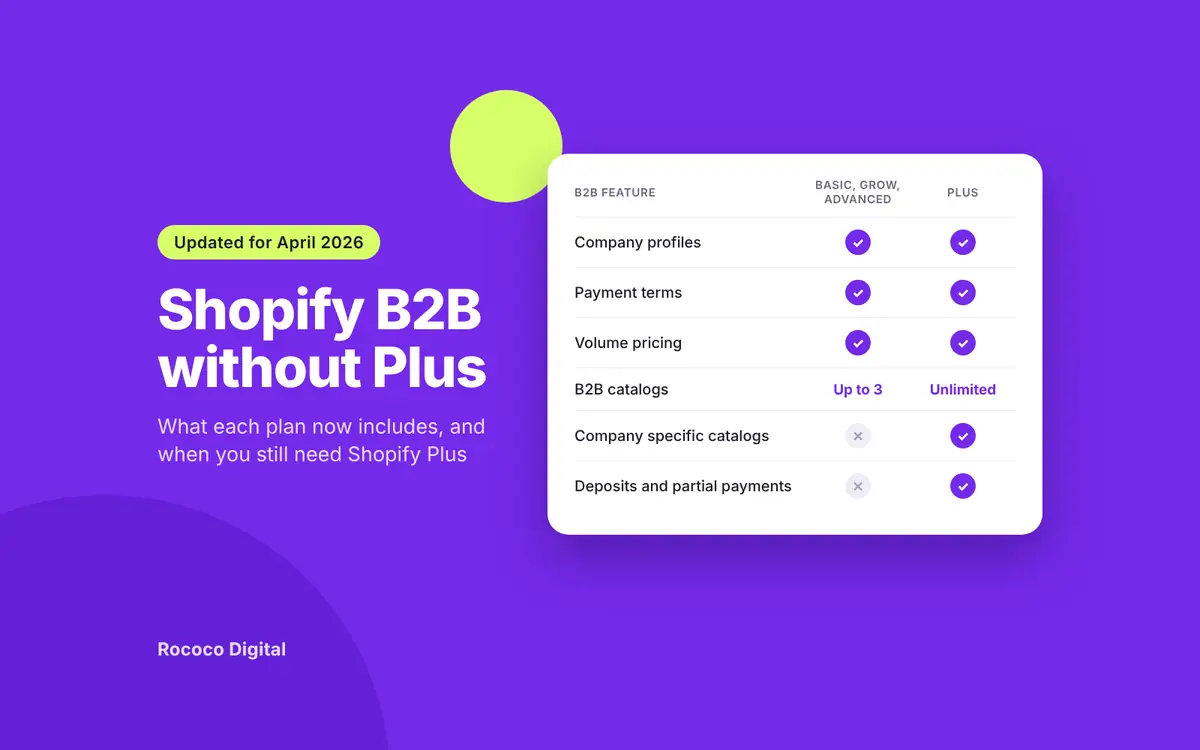
Until April 2026, selling wholesale through Shopify’s built in B2B features meant paying for Shopify Plus. On 2 April 2026 Shopify brought the core B2B features to the Basic, Grow and Advanced plans at no extra cost. That changes the maths for a lot of UK brands with a trade side. This guide sets out what each plan now includes, what still needs Plus, and how to decide.
| The short answer Shopify B2B now runs on Basic, Grow, Advanced and Plus, but not on Starter or Retail. The standard plans get company profiles, payment terms, volume pricing and vaulted cards, with up to three B2B catalogs assigned through Markets. Plus adds unlimited catalogs, catalogs assigned to individual companies and locations, deposits and partial payments. |
What changed in April 2026
Shopify’s changelog for 2 April 2026 announced key B2B features on non Plus plans, at no additional cost. Before that, a store on Advanced that wanted trade pricing, net terms or company accounts had three options: upgrade to Plus, run a separate wholesale store, or rely on a wholesale app. Many UK brands chose an app or a second store. For some of them, the native features are now enough.
Shopify B2B features by plan
| Feature | Basic, Grow and Advanced | Shopify Plus |
|---|---|---|
| Company profiles for trade customers | Yes | Yes |
| Payment terms (for example, net 30) | Yes | Yes |
| Volume pricing | Yes | Yes |
| Vaulted credit cards | Yes | Yes |
| B2B catalogs (trade price lists) | Up to 3 active, assigned through Markets | Unlimited |
| Catalogs assigned to a specific company or location | No | Yes |
| Deposits | No | Yes |
| Partial payments | No | Yes |
| Starter and Retail plans | B2B not available | |
The detail that matters most is how catalogs are assigned. On the standard plans, a catalog is attached to a market, so every trade buyer in that market sees the same prices. On Plus, you can give one company its own price list. If you negotiate prices account by account, that is the line between the two.
Who the standard plans now suit
- Brands with one trade price list, or a few tiers such as retail, trade and distributor. Three catalogs covers most of these.
- Stores that offer net terms to approved stockists and want orders and invoices in one place rather than by email.
- Stores with a small number of trade accounts that currently order by phone, email or a PDF order form.
When you still need Shopify Plus
- Customer specific pricing. If each account has its own negotiated prices, you need catalogs assigned to companies or locations, which is Plus only.
- More than three price lists. Distributors with many tiers or regions will hit the catalog limit.
- Deposits or partial payments on large or made to order trade orders.
- The wider Plus case. Checkout customisation, expansion stores and Shopify Functions may matter more than B2B on its own. Our guide to Shopify vs Shopify Plus covers the rest.
When native B2B is not enough on any plan
Shopify’s B2B features handle the storefront and the order. They do not replace your ERP. If stock, pricing and account data live in Business Central, NetSuite or Sage, the work is in the integration: syncing customer specific prices, credit limits, order history and stock in both directions. That is where most B2B projects spend their time and budget, whichever plan you are on.
Some businesses also need a trade portal that does more than a store: reordering from history, approval steps, account level reporting or quote requests. We cover those builds on our B2B portal development page.
How to decide
- Count your price lists. Three or fewer, shared by groups of customers, fits the standard plans. One per customer needs Plus.
- List your payment terms. Net terms are on every B2B plan. Deposits and partial payments need Plus.
- Map your systems. If an ERP holds your prices and stock, scope the integration before you choose the plan.
- Check your apps. If you pay for a wholesale app today, compare what it does with the native features before you cancel it.
If you sell to trade customers and want a second opinion on whether the standard plans now cover it, our B2B eCommerce team can scope it with you, from a handful of trade accounts to multi site distributors.
Shopify B2B FAQs
Do you need Shopify Plus for B2B?
Not any more for the basics. Since 2 April 2026, Shopify B2B runs on Basic, Grow and Advanced, with company profiles, payment terms, volume pricing and up to three catalogs. You still need Plus for customer specific catalogs, more than three catalogs, deposits and partial payments.
Which Shopify plans do not include B2B?
Shopify B2B is not available on the Starter or Retail plans.
How many B2B price lists can I have on Shopify Advanced?
Up to three active B2B catalogs, assigned through Markets. Every buyer in a market sees that market’s catalog. Plus allows unlimited catalogs and can assign them to individual companies.
Can I run B2B and DTC from one Shopify store?
Yes. B2B customers log in to company accounts on the same store and see their trade prices and terms, while retail shoppers see your normal prices.
Sources
- Shopify Changelog, Key B2B features now available on non-Plus plans, 2 April 2026.
- Shopify Help Center, B2B.
Checked on 30 October 2026. Shopify changes plan features often, so check the current B2B features by plan page before you decide.