
Choosing a Shopify Plus agency is usually a bigger decision than choosing Shopify Plus. The platform is the same for everyone; the agency decides how well it is built, whether your rankings survive the move, and whether the store keeps growing after launch. This guide sets out how to brief agencies, where to find them, the questions that separate good answers from sales answers, the red flags to watch for, and how to compare proposals. We are a Shopify Plus agency ourselves, so we have tried to write the guide we would want a client to use on us.
| The short answerStart with a written brief: what the store must do, your budget, your timeline and how you will measure success. Shortlist three agencies with Plus builds or migrations like yours, using Shopify’s Partner Directory, referrals and reviews rather than self-published "top agency" lists. Ask who will do the work, how they protect SEO in a migration, which integrations they have built, and what happens after launch. Compare fixed proposals against the same scope, speak to two or three of their clients, and make sure the store, accounts, code and data stay in your name. |
Start with the brief, not the agency
Shopify’s own advice to merchants hiring a Partner is to define your budget, timeline and expected outcomes in detail, so the Partner can give an accurate quote. That step is often skipped, and it is why proposals end up impossible to compare. A useful brief covers:
- Why you are moving or rebuilding. The business problem, such as trade orders by email, a checkout you cannot change, a new market or a platform you have outgrown.
- What the store must do. B2B, international markets, subscriptions, retail locations, and the systems it must connect to, such as your ERP, warehouse or 3PL.
- What you have now. Platform, catalogue size, apps, integrations and the pages that earn your organic traffic.
- Budget and timeline. A range is fine. Without one, agencies will guess, and their guesses will not match.
- How success is measured. Revenue, conversion rate, average order value, organic traffic, time saved. Pick the few that matter.
If you are not yet sure Plus is the right platform, settle that first. Our Shopify vs Shopify Plus and Shopify Plus pricing guides cover the decision, and our Shopify consultants can give an independent view before you brief anyone.
Where to find Shopify Plus agencies
Shopify’s Partner Directory. Shopify describes it as a curated list of Shopify Partners. Profiles show services, pricing, reviews and ratings, and you can filter by services and price range. Partners carry tier badges, which Shopify describes like this:
| Tier | How Shopify describes it |
|---|---|
| Select | Best for small and medium-sized businesses |
| Plus | Best suited for mid-market and larger businesses |
| Premier | Designed for large enterprises |
| Platinum | Tailored for global enterprise businesses |
Tiers are a useful signal of scale and Shopify activity, but they are not a measure of fit. A smaller specialist that has done exactly your kind of migration can be a better choice than a larger partner whose team on your project is junior. Reviews on the Directory come from merchants on paid plans and appear within 48 hours, so read the comments, not just the stars.
Referrals. Ask brands you respect, your app and 3PL providers, and your payment provider who they work with. People who have been through a migration will tell you what went wrong.
“Top agency” lists. Treat these with care. Many are written by agencies that put themselves first. They are useful for building a long list, not for choosing.
Questions to ask every agency
| Question | What a good answer sounds like |
|---|---|
| Which Plus projects have you done that look like ours? | Named examples with similar size, platform or complexity, and results you can check |
| Who will actually work on our project? | Named people, their roles and how much of their time you get, including after launch |
| How do you protect our rankings in a migration? | A crawl and baseline first, every indexed URL mapped to a redirect, and monitoring after launch |
| Which of our systems have you integrated before? | Specific experience with your ERP, warehouse or 3PL, and a plan for testing the data |
| How will you handle B2B or international, if we need it? | A view on Shopify B2B, Markets and expansion stores for your case, not a default answer |
| What is fixed in your price, and what is not? | A fixed proposal against a written scope, with change requests priced separately |
| What happens after launch? | A defined support period and a clear plan for growth, whether with them or your team |
| What would make you tell us not to do this? | A real answer. Good agencies turn work down when it is not right |
Red flags
- The pitch team disappears. If the senior people who sold the project will not be on it, find out who will.
- No SEO plan for a migration. If redirects are described as a launch week task, your organic revenue is at risk.
- A quote with no scope. A low number against a vague scope usually grows. A fixed price against a written scope is easier to hold to.
- Everything needs an app. Shopify Plus already covers a lot through Flow, Functions, B2B and Markets. An agency that adds an app for every requirement is adding cost and speed problems.
- Accounts in their name. Shopify says a Partner may need access to your store through a collaborator account. The store, domain, apps and data should belong to you.
- No references you can call. Case studies are curated. A conversation with a client is not.
How to compare proposals
Ask each shortlisted agency to respond to the same brief, then compare on the same terms:
| Compare | Why it matters |
|---|---|
| Scope | The same requirements, line by line. Gaps are where extra costs appear later |
| Team | Named people, seniority and time on your project |
| Plan | Phases, dates and when you see working software, not just designs |
| Migration and SEO | Redirects, data migration and how rankings are monitored |
| Price | Fixed or estimated, what is included, and how changes are priced |
| After launch | Support period, response times and the growth plan |
Many agencies start with a paid discovery or audit phase. That is a good sign rather than a sales trick, because it produces a scope you can take to any agency. Our own Plus projects start with a growth audit for the same reason, and our Shopify Plus agency page explains how we work.
What a Shopify Plus agency costs
There is no standard price. The main drivers are the size of the catalogue, how many systems the store connects to, B2B and international requirements, whether the design is custom, how much content moves, and whether you are migrating from another platform. Some agencies publish starting prices and many do not, so ask each one for a fixed figure against your brief.
Remember that the agency fee sits on top of the platform. Shopify Plus starts at £1,800 a month in the UK on a three year term, plus card fees and apps, so the full cost of a Plus store over three years is the build, the licence and the ongoing work together. Our Shopify Plus pricing guide covers the platform side, and our FAQs below give our own prices.
Build agency, growth agency or both?
Some brands use one agency to build the store and another to grow it through SEO, paid media, email and conversion work. That can work, but the handover is where problems hide: tracking that breaks at launch, SEO decisions made by developers, and a growth team inheriting a store it did not design. Using one team for both removes that handover, provided the agency is strong at both. Whichever you choose, make sure the people who will grow the store are involved before the build is designed.
Running the selection
1. Write the brief. Requirements, budget range, timeline and success measures.
2. Build a long list. Partner Directory, referrals and your own research, then cut to three agencies with relevant work.
3. Brief all three the same way. Same document, same questions, same deadline.
4. Meet the delivery team. Ask to meet the people who will do the work, not just the people who sell it.
5. Call references. Ask what went wrong and how the agency handled it.
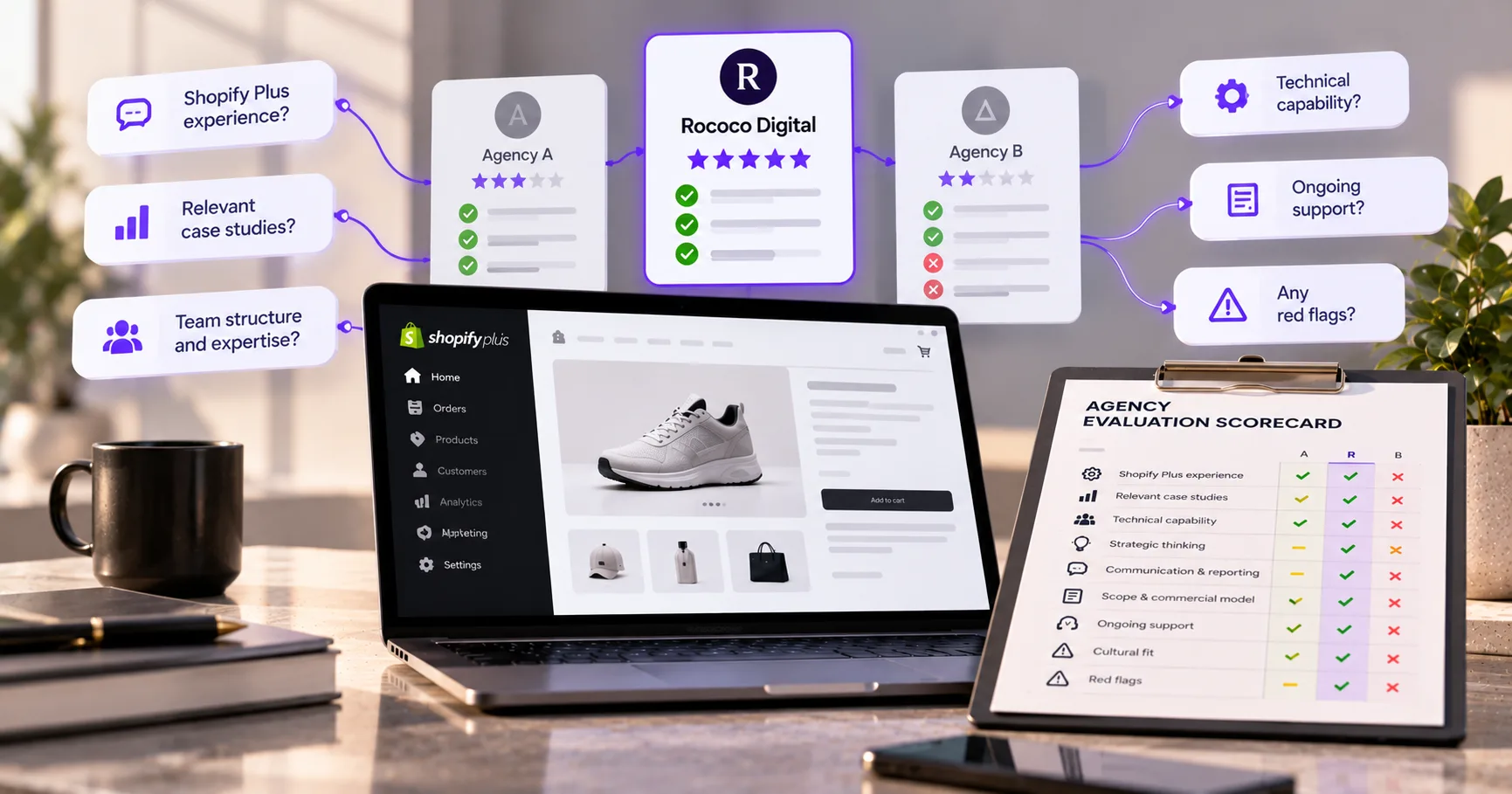
6. Score the proposals. Use the scorecard above, then check the contract for scope, ownership and change pricing.
7. Start with discovery. A paid audit or discovery phase de-risks the build and gives you a scope you own.
If you are planning a move to Shopify Plus, our Shopify Plus migration guide covers what the project involves, so you can judge whether each agency’s plan holds up.
Frequently asked questions
A Shopify Plus agency plans, builds, migrates and grows stores on Shopify’s enterprise plan. Typical work includes custom builds, migrations from Magento or WooCommerce, B2B and international set-ups, ERP and warehouse integrations, checkout customisation and ongoing SEO, paid media, email and conversion work.
Not necessarily. Shopify’s partner tiers, Select, Plus, Premier and Platinum, signal scale and Shopify activity, and Shopify describes Plus tier partners as best suited for mid-market and larger businesses. What matters most is relevant work, the team on your project and a sound plan for migration and SEO.
Shopify’s Partner Directory shows reviews and ratings on partner profiles, from merchants on paid plans. Read the comments as well as the scores, ask for case studies with results you can check, and speak to two or three of the agency’s clients directly.
It depends on scope. At Rococo, Shopify and Shopify Plus builds and migrations start from £20,000, with heavily integrated, B2B or international projects going higher, and ongoing growth retainers start from £4,000 a month. Every project is priced as a fixed proposal after a growth audit.
It depends on catalogue size, integrations, B2B and the number of markets. Most of our migrations to Shopify Plus run 10 to 16 weeks from kick off to launch, with redirect and data work starting in week one.
Yes. Shopify says a Partner may need access to your store through a collaborator account, which you control. The store, domain, apps, theme code and data should belong to you, so you can change agency without losing anything.
It can remove the handover between build and marketing, which is where tracking, SEO and conversion problems often appear. If you use two agencies, involve the growth team before the build is designed.
Related reading: Shopify Plus migration, Shopify Plus pricing, Shopify Plus SEO and What is Shopify Plus?.
| Shortlisting Shopify Plus agencies?A 30 minute call with our two co-founders, who scope and run every Plus project. Bring your brief, or the questions above, and we will tell you plainly whether we are the right fit. Book a growth call. |