
Ask five UK agencies what an eCommerce website costs and you will get five different numbers, and most of the guides ranking for the question are written in US dollars. This guide gives UK figures: what a store costs to build at each level, what it costs to run each month on Shopify and WooCommerce, the costs people forget, and how to budget for the first year. Platform prices are taken from Shopify’s and WooCommerce’s own pricing pages, checked on 25 November 2026.
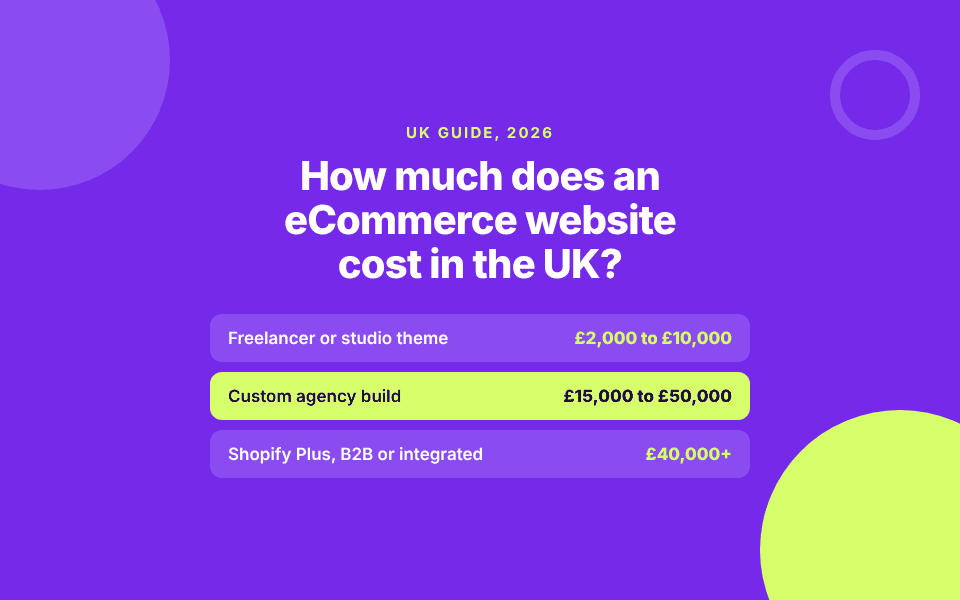
| The short answer A store you set up yourself on a ready made theme can launch for under £1,000 plus a monthly plan. A theme set up by a freelancer or small studio typically costs £2,000 to £10,000. A custom designed store built by an agency typically costs £15,000 to £50,000, and Shopify Plus, B2B or heavily integrated builds run from £40,000 upwards. On top of the build, Shopify’s UK plans cost £25 to £344 a month (£19 to £259 paid yearly), plus card fees on every sale. |
eCommerce website cost by type of build
The biggest factor is who builds the store and how much of it is designed from scratch. These are the typical ranges for UK projects. They cover the build only, not the monthly running costs further down.
| Type of build | Typical UK build cost | What you get | Suits |
|---|---|---|---|
| Do it yourself on a ready made theme | Under £1,000 | A free or paid theme, your own products and content, standard apps | New brands testing demand with a small range |
| Theme set up by a freelancer or small studio | £2,000 to £10,000 | A paid theme configured and styled to your brand, products loaded, payments and shipping set up | Small shops that need it done properly but not designed from scratch |
| Custom designed store built by an agency | £15,000 to £50,000 | Bespoke design, custom theme development, migration from your old site, SEO and tracking set up, testing | Established brands where the store is the main sales channel |
| Shopify Plus, multi market or heavily integrated | £40,000 to £150,000 or more | Everything above, plus checkout customisation, several markets or stores, and links to ERP, warehouse or EPOS systems | Brands with high volume, international sales or complex operations |
| B2B store or trade portal with ERP integration | £30,000 to £100,000 or more | Trade accounts, customer pricing, quick order and reorder, and a two way sync with your ERP | Manufacturers, wholesalers and distributors |
Shopify’s own guide to eCommerce website costs puts ready made themes at $0 to $500 and custom development at “$2,000 to $20,000 or more depending on complexity”. The gap between that and UK agency builds is mostly design, migration, integrations and the testing that stops a launch costing you sales.
What drives the cost of a build
- Design. A paid theme styled to your brand is quick. A custom design means a designer works through the home page, collection pages, product pages, basket and content templates before a developer starts.
- Number of templates. Each page type that behaves differently (bundles, subscriptions, configurable products, landing pages) is more design and build time.
- Catalogue and data. A few hundred simple products is quick to load. Thousands of products with variants, filters, specification data and images take planning and cleaning.
- Migration. Moving from Magento, WooCommerce or another platform means moving products, customers and order history, and redirecting every old URL so you keep your rankings. Our guide to migrating to Shopify Plus covers what that involves.
- Integrations. Links to an ERP, EPOS, warehouse, accounting or CRM system are often the largest single cost on a bigger project, because data has to move reliably in both directions.
- B2B and international. Trade pricing, payment terms, several currencies and languages, and local tax and shipping rules all add scope.
- Content. Product copy, photography and category content are often left out of a quote and then become the reason a launch slips.
Monthly running costs on Shopify
Shopify is a hosted platform, so the plan fee covers hosting and security. These are the UK prices on Shopify’s pricing page.
| Shopify plan | Paid monthly | Paid yearly (per month) | UK online card rate |
|---|---|---|---|
| Basic | £25 | £19 | 2% + 25p |
| Grow | £65 | £49 | 1.7% + 25p |
| Advanced | £344 | £259 | 1.5% + 25p |
| Plus | From £1,800 | On a 1 or 3 year term | From 1.3% + 25p |
Card fees usually cost more than the plan once a store is trading. A store taking £20,000 a month on Basic pays around £400 in percentage fees before the 25p per order. Our Shopify fee calculator works out the plan and fees for your own revenue and order numbers. For Plus, see our guide to Shopify Plus pricing in the UK.
Other running costs on Shopify:
- Apps. Reviews, subscriptions, search, loyalty and email are usually paid apps with their own monthly fees. Add them up before you launch, because they grow with your order volume.
- Shopify POS Pro if you sell in person: £69 a month per location.
- Domain. A custom domain can be connected on every plan. Shopify’s guide puts the domain itself at $10 to $30 a year.
- Email marketing. Most growing stores use Klaviyo or a similar tool, billed by the number of contacts. See our guide to Klaviyo pricing in the UK.
Monthly running costs on WooCommerce
WooCommerce is free to download and has no platform fee or revenue share. You pay for the things Shopify includes in its plan instead. WooCommerce’s own pricing page puts hosting at “$25 to $350/month for most stores” and paid extensions at “$29 to $299/year per extension”. Card fees depend on the payment provider you choose.
The cost that is easy to miss on WooCommerce is maintenance. WordPress, WooCommerce and every plugin need updating and testing, and someone has to be responsible for security and speed. If you do not have a developer in house, budget for a support contract. Our comparison of Shopify vs WooCommerce sets out where each one works out cheaper.
The costs people forget
- Redirects and SEO on a replatform. Skipping the redirect map is the most expensive saving you can make, because lost rankings cost sales for months.
- Photography and product copy. A new design shows up weak images and thin descriptions.
- Tracking. GA4, Google Ads and Meta conversion tracking, and a cookie banner that meets UK rules. Our Consent Mode v2 guide covers the consent side.
- VAT. UK agency quotes are usually given before VAT. If the agency is VAT registered, 20% is added to the invoice.
- Support after launch. Fixes, small changes and app updates in the months after go live.
- Marketing budget. A new store does not bring its own traffic. Plan for SEO, paid media or email from launch day.
How to budget for year one
Add four numbers together:
- The build, from the table above, plus VAT if it applies.
- Twelve months of platform costs: the plan, apps and, on WooCommerce, hosting and extensions.
- Payment fees on the revenue you expect, which the fee calculator works out for Shopify.
- Support and marketing after launch.
The cheapest build is rarely the cheapest year. A store that converts poorly or loses its rankings in a migration costs more in lost sales than the difference between two quotes.
How to get an accurate quote
- Write a short brief: your current platform, product count, monthly revenue, the systems the store must connect to, and any must have features.
- Ask what is included: design rounds, migration, redirects, tracking, testing, training and support after launch.
- Compare like for like. A low quote often leaves out migration, integrations or content.
- Ask who does the work and whether the same team supports the store after launch.
Our guide on how to choose a Shopify Plus agency has a fuller list of questions. If you are planning a new store or a move to Shopify, our Shopify development agency team can scope it with you, and our Shopify migration page covers moves from Magento, WooCommerce and other platforms.
eCommerce website cost FAQs
Under £1,000 if you set it up yourself on a ready made theme, typically £2,000 to £10,000 for a theme set up by a freelancer or small studio, £15,000 to £50,000 for a custom designed store built by an agency, and £40,000 or more for Shopify Plus, B2B or heavily integrated builds. Monthly platform and card fees come on top.
Shopify’s UK plans cost £25, £65 or £344 a month paid monthly, or £19, £49 or £259 a month paid yearly. Shopify Plus starts at £1,800 a month. Card fees on Shopify Payments run from 2% + 25p on Basic down to 1.5% + 25p on Advanced, plus any paid apps.
WooCommerce has no platform fee, but you pay for hosting, paid extensions and maintenance instead. WooCommerce puts hosting at $25 to $350 a month for most stores. Which one is cheaper depends on your revenue, the features you need and whether you have a developer to maintain it.
UK agency quotes are usually given before VAT. If the agency is VAT registered, VAT at the standard rate of 20% is added to the invoice.
Our Shopify and eCommerce builds start from £20,000. That covers custom design and development by our own team, migration and redirects where needed, tracking and testing. Larger Shopify Plus, B2B and integration projects are scoped individually.
Sources
- Shopify, UK pricing, checked 25 November 2026.
- Shopify, Ecommerce website cost, updated 6 November 2026.
- WooCommerce, Pricing, checked 25 November 2026.
- GOV.UK, VAT rates.
Platform prices checked on 25 November 2026. Shopify and WooCommerce change their prices from time to time, so check their pricing pages before you budget.